
Trade Show Lead Nurturing: The 90-Day Plan for Leads That Didn’t Buy
BoothMaven Editorial Team·
July 27, 2026·
20 min read·
CL-37 Spoke · Repurpose: LI
A 90-day trade show lead nurture plan delivers 10 value-led emails to cold and warm leads who were not ready to buy at the event — spaced every 8–14 days, segmented by industry, and structured across three phases: Establish (days 1–30, build presence and provide value), Deepen (days 31–60, demonstrate expertise and social proof), and Convert (days 61–90, introduce decision-stage content and soft prompts). The sequence runs automatically. Leads that engage trigger an immediate escalation to active rep follow-up. Leads that do not engage after 90 days move to a quarterly light-touch programme.
The majority of leads captured at any trade show will not buy on the timeline the exhibitor hopes for. A visitor who said “we are interested but it is not the right time yet” at the show is telling the truth — not giving a polite brush-off. That visitor may have a contract expiring in six months, a budget cycle opening in Q1, or a business problem that has not yet risen to priority status. When one of those triggers fires, the vendor they remember — the one whose name came up in a useful email last month — wins the evaluation.
The 90-day nurture plan is the infrastructure that keeps your brand relevant during the gap between the show conversation and the buying decision. It is not a pressure programme. It does not manufacture urgency that does not exist. It is a trust-building system that earns the right to a conversation when the lead is ready to have it.
This guide gives you the complete 90-day plan: content framework by phase, email cadence, industry segmentation rules, engagement escalation triggers, and the measurement approach that tells you whether the sequence is working. For the full follow-up system: trade show follow-up: the complete guide.
The Difference Between Follow-Up and Nurturing
Follow-up is what happens in the first 48 hours after a show: personalised direct outreach to hot and warm leads, referencing the specific conversation, with a direct ask for a next step. It is rep-driven, conversation-referenced, and time-sensitive.
Nurturing is what happens over the following 90 days to leads who are not yet ready for a buying conversation: automated, value-led content that builds presence and credibility without sales pressure. It is system-driven, content-referenced, and not time-sensitive in the same way.
The failure mode is confusing the two: sending nurture content to hot leads (they interpret it as disinterest), or sending follow-up urgency to cold leads (they interpret it as pressure and unsubscribe). The Hot/Warm/Cold system in the lead prioritisation guide determines which approach each lead receives. Cold leads go to nurture from day one. Warm leads go to a short personalised sequence first, then transition to a nurture-style cadence from touch three onwards if they have not engaged actively.
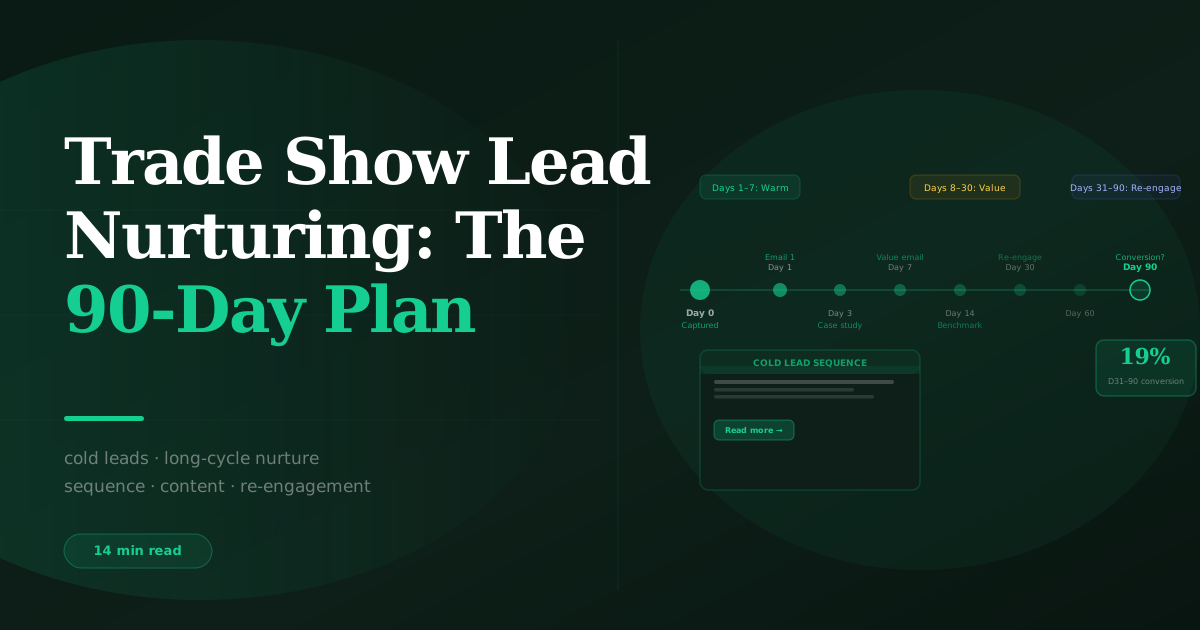
Across BoothMaven customers tracking cold lead conversion at North American trade shows, 6% of leads classified as cold at the event had converted to sales opportunities within 30 days of the show close. By day 90, that figure had risen to 19% — more than three times as many cold leads became active opportunities during the nurture window as did in the first 30 days. The conversion rate increase across days 31–90 demonstrates that cold leads are not permanently cold: they are time-shifted opportunities that convert when their buying cycle conditions change, not when the exhibitor wants them to.
Phase 1 — Establish: Building Presence in the First 30 Days
The first phase of the nurture sequence does one thing: establish that your company is worth having in the lead’s inbox. The emails in this phase deliver value before making any ask, use the show reference as context without leaning on it heavily, and set the tone for the relationship — helpful, relevant, and low-pressure.
Email 1 — Day 1–3: Brief show reference + one genuinely useful resource
The first nurture email arrives within three days of the show close. It is not a follow-up email — it does not assume the recipient remembers the specific conversation in detail. The opening line references the show briefly (“From [show name] last week — “), then immediately delivers value: a piece of content directly relevant to the contact’s industry or role. No ask beyond “here is a resource I thought might be useful.” The goal is to establish the inbox relationship on a positive note: this company sends useful things, not sales pitches.
Content type: a benchmark report, a practical how-to guide, or an industry insight relevant to their role. Do not gate this content behind a form — the contact is already in your database. Give it to them directly. A gated first nurture email produces lower click rates and establishes a transactional rather than a helpful relationship dynamic.
Email 2 — Day 10–12: Industry benchmark or data point
The second nurture email delivers a specific data point relevant to the contact’s industry. The ideal format: one statistic that is genuinely surprising or useful, two to three sentences of context, and a link to the full report or breakdown if one exists. This email establishes credibility — your company not only has knowledge, it has data. Data-led emails in nurture sequences consistently produce higher click rates than opinion or advice-led emails because they offer something the reader cannot easily get elsewhere.
At this point, if the contact’s industry has been populated by badge data or CRM enrichment, segment the send: manufacturing contacts receive manufacturing benchmark data, SaaS contacts receive SaaS event data. Generic data is less effective than sector-specific data, and the segmentation step adds no extra work if your CRM properties are configured correctly from the show sync.
Email 3 — Day 20–22: Practical how-to guide for their role
The third nurture email delivers a practical guide — something that helps the contact do their job better in the domain relevant to your product. For BoothMaven, this might be “a booth team training guide for the next event” or “the pre-event setup checklist” — practical, downloadable, immediately useful. The content is not about your product specifically; it is about the problem space your product operates in. A guide that helps the reader succeeds regardless of whether they buy from you, which is precisely why it builds trust.
By the end of Phase 1, a lead who has engaged with all three emails has seen your company demonstrate sector knowledge (email 2) and operational helpfulness (email 3). They are better positioned for the Phase 2 content, which introduces social proof and product-adjacent content.
Phase 2 — Deepen: Building Credibility Through Social Proof and Expertise
Phase 2 introduces content that demonstrates what your product does for people like the lead — not through product descriptions, but through peer evidence (case studies), practical application (feature spotlights in context), and community connection (upcoming events or webinars where the lead can engage without commitment).
Email 4 — Day 32–35: Customer case study from their industry vertical
The case study email is the single highest-performing content type in the 31–60 day nurture window, based on BoothMaven customer data. A case study featuring a company recognisably similar to the lead’s organisation — same industry, similar size, similar use case — produces click rates significantly above the sequence average. The reason is that a case study resolves the lead’s primary unspoken question: “does this work for companies like mine?”
Case study format for nurture emails: company type and size in the subject line, one sentence of problem statement, one sentence of solution, one key metric. Link to the full case study. Under 200 words total in the email. The brevity respects the reader’s time and increases click-through to the full case study, where the detail lives.
Subject line: “How [company type similar to theirs] [specific result relevant to their stated concern]”
Email 5 — Day 42–45: Feature spotlight tied to a use case
The feature spotlight email introduces a specific product capability in the context of a problem the lead cares about — drawn from the qualifying question answers or voice note from the event. This is not a product brochure. It is a one-feature, one-use-case, one-outcome email: “Here is how [feature] handles [specific problem] — and why it matters if your team does [their situation].”
If the voice note from the booth is accessible and indicates a specific feature the visitor asked about, use that feature here. If not, select the feature most commonly relevant to leads in this industry segment. The use-case framing — not the feature description — is what generates the click. “Voice notes that auto-transcribe booth conversations” is a feature description. “Never lose the context of a hot lead conversation when you hand off to a different rep” is a use case. The second version produces more clicks in nurture emails.
Email 6 — Day 52–55: Upcoming event invitation or webinar
The sixth nurture email invites the lead to an upcoming event — a webinar, a virtual roundtable, a conference panel, or a show where you will be exhibiting. This email serves two purposes: it provides a low-commitment engagement opportunity (attending a webinar is easier than agreeing to a demo), and it identifies engaged leads by who registers. A lead who registers for a webinar has demonstrated active interest and should trigger the engagement escalation workflow regardless of whether they have met the open/click threshold.
Event invitations also naturally reset the nurture clock: a lead who attends a webinar 45 days after the show is effectively a new warm lead for follow-up purposes — their engagement is recent, their interest is demonstrated, and a post-webinar follow-up email is a logical and welcome contact.
Phase 3 — Convert: Decision-Stage Content and Soft Prompts
Phase 3 introduces content designed for leads approaching a decision — ROI frameworks, peer comparison guides, and direct but low-pressure decision prompts. The convert phase does not pressure cold leads who are still not ready; it provides the tools needed by leads who are beginning to move. Both audiences receive the same emails; the engaged leads use the content, the unengaged leads ignore it without unsubscribing.
Email 7 — Day 62–65: ROI framework or business case guide
The ROI email gives the lead the framework for building an internal business case. It does not tell them what ROI to expect — that is a performance claim that varies by situation. It tells them how to calculate the ROI of a solution like yours, which inputs to use, and what typical ranges look like for companies their size. A business case framework is one of the most useful resources a vendor can provide to an internal champion who needs to justify a purchase decision to a finance team or management layer above them.
Email 8 — Day 72–75: Competitor comparison guide (if applicable)
The comparison guide email is optional and only appropriate if the lead indicated they were evaluating multiple vendors (either in a qualifying question answer or in the voice note). A comparison guide that addresses the specific evaluation criteria the lead raised at the show is more useful than a generic comparison. For leads with no indicated competitor evaluation, substitute a “questions to ask any vendor” guide, which positions your company as the transparent choice without directly naming competitors.
Emails 9–10 — Day 82–90: Decision prompts and graceful exit
The final two emails in the 90-day sequence are the softest asks in the nurture programme. Email 9: “Have circumstances changed since [show name]? If your timing has shifted, I’d love to pick up the conversation.” Email 10: “Last email from me for a while — if the timing isn’t right, that is completely fine. When it is, [Calendly link].”
These permission-based final touches consistently produce open rates among the highest in the sequence. The honesty of the framing — explicitly acknowledging that the timing might not be right — generates goodwill and reply rates that softer-pressure emails do not. A meaningful number of leads reply to email 10 with “actually, now is a better time” — converting cold leads into active pipeline at the final touch.
How to Segment the 90-Day Sequence by Industry and Role
A single generic 90-day sequence works. An industry-segmented 90-day sequence works significantly better. The segmentation investment — creating two to four industry variants of the same sequence framework — produces open rate improvements of 20–35% and click rate improvements of 30–50% compared to the unsegmented version, based on BoothMaven customer A/B data.
The minimum segmentation approach: create two variants — technical/SaaS and non-technical/trade sectors. The content difference: technical variant uses data, API references, integration examples; non-technical variant uses operational examples, field-tested case studies, practical checklists. The subject lines, sender name, and send cadence are identical. Only the content changes.
The fuller segmentation approach: four variants — SaaS/technology, manufacturing/industrial, healthcare/life sciences, and financial services. Each variant uses sector-specific benchmark data (email 2), case studies from that vertical (email 4), and feature spotlights relevant to that sector’s primary use case (email 5). The time investment to create four variants is approximately double the time to create one — but the performance improvement justifies it within the first show cycle.
Routing logic in your CRM
Segment routing happens at enrolment: when BoothMaven syncs a new contact with Industry = “Software & Technology”, the Cold Nurture workflow routes that contact to the SaaS sequence. Industry = “Manufacturing” routes to the manufacturing sequence. Contacts without an industry field (which occurs when badge data does not include it) enrol in the default generic sequence and are re-routed to the correct industry sequence when enrichment data is applied — typically within 24–48 hours of capture.
Configure BoothMaven to capture the industry field from badge registration data wherever available. For shows where badge data does not include industry, use the qualifying question “Which best describes your company?” with industry options as the routing source. See BoothMaven content signals for engagement tracking that triggers escalation.
When to Pull a Lead Out of Nurture and Into Active Follow-Up
The 90-day nurture sequence is not a set-and-forget system. Engagement signals throughout the sequence indicate that a lead’s buying cycle conditions have changed — and when those signals appear, the lead should move from automated nurture to active rep follow-up immediately, not at the end of the 90-day window.
The four escalation triggers
- Three or more email opens in a 30-day window. A cold lead who opens three consecutive nurture emails is not reading passively — they are actively following the content. This level of sustained engagement indicates that a buying trigger has occurred or is approaching. Escalate to warm follow-up and create a rep task.
- Two or more link clicks. A click indicates active interest — the lead took an action beyond passive reading. Two clicks in the nurture sequence, particularly on different content types, indicates evaluation-level engagement. Escalate to warm.
- Pricing page visit after clicking a nurture email link. A lead who clicks from a nurture email to the website and then visits the pricing page has moved from content consumption to commercial evaluation. This is the highest-intent escalation signal in the nurture sequence. Escalate to hot or warm immediately and create a rep task due today.
- Direct reply to any nurture email. Any reply — even “please take me off your list” — is an engagement signal. A positive reply (“actually, the timing is better now”) is an immediate hot or warm escalation. An unsubscribe request is actioned within 10 business days as required by CAN-SPAM and Canadian CASL.
USA (CAN-SPAM): Commercial nurture emails to US contacts require a valid physical address in the footer, a working unsubscribe mechanism honoured within 10 business days, and an accurate From address. No consent is required for initial commercial email contact to US recipients from a trade show relationship, but unsubscribe requests must be honoured. Include the unsubscribe footer in every automated nurture email.
Canada (CASL): Implied consent from a trade show interaction permits commercial email for a time-limited period — typically two years from the date of interaction. Configure your CRM to track the CASL consent date for Canadian contacts (BoothMaven populates this field at sync time) and suppress contacts whose consent window has expired. French-language or bilingual nurture content variants for Quebec Francophone contacts improve engagement rates and demonstrate awareness of the contact’s language context.
Cold leads are time-shifted opportunities, not lost leads. BoothMaven data shows that more than three times as many cold leads convert to active opportunities between days 31–90 than in the first 30 days after a show. The 90-day nurture sequence is the infrastructure that captures those conversions.
The sequence earns attention through value, not through volume. Ten emails over 90 days is less than one email per week — a cadence that stays present without overwhelming. Every email must deliver standalone value. An email that does not give the reader something genuinely useful has a negative net effect on the relationship.
Escalation triggers, not fixed timelines, are the correct signal to move from nurture to direct outreach. A lead that engages with email 4 on day 35 is more ready for a conversation than a lead that receives email 10 on day 88 without engaging. Configure the escalation workflow to fire on engagement signals, not on sequence completion.
How to Measure Whether the 90-Day Sequence Is Working
Three metrics tell you whether the nurture sequence is performing correctly: open rate trend (should hold flat or rise across the 10 emails — a sharp decline after email 3 indicates content relevance issues), escalation rate (what percentage of cold leads are escalating to warm via the engagement triggers — target 8–15%), and post-90-day pipeline contribution (what percentage of show-sourced pipeline originated from a cold lead who was nurtured before converting).
The last metric — pipeline contribution from nurtured leads — is the most important for demonstrating the value of the nurture programme to leadership. It requires that your CRM correctly attributes the lead’s original source to the show and tracks the sequence enrolment and escalation event. Configure these attribution fields before the first show, not retrospectively: clean attribution data from the first show makes the business case for nurture investment in subsequent shows straightforward to present.
Review all three metrics after each 90-day cycle. The most common finding in the first review: email 3 or 4 content is not resonating — either because it is not industry-specific enough, or because the topic does not match what leads in that segment actually care about. Rewriting emails 3–4 based on the first cycle’s data typically improves escalation rates by 30–40% in the second cycle. The sequence improves with each show; the first cycle produces baseline data that makes every subsequent cycle better.
Frequently Asked Questions
USA: Commercial nurture emails to US contacts can begin immediately after the show under CAN-SPAM’s opt-out framework. Include a valid physical address and working unsubscribe in every email. No consent is required beyond the trade show business relationship for initial contact, but unsubscribe requests must be honoured within 10 business days.
Canada: CASL implied consent from a trade show interaction permits commercial email for approximately two years. Track the consent date in your CRM (BoothMaven populates this at sync) and suppress Canadian contacts whose consent window has expired. For Quebec Francophone contacts, French-language or bilingual nurture variants produce better engagement rates than English-only sequences. Canadian public sector contacts may have compressed summer responsiveness — allow extended reply windows June–August.
Conclusion
The 90-day trade show lead nurture plan is the part of the event lead programme that most exhibitors either skip or do badly. The ones who skip it lose the long-cycle pipeline that their show investment generated. The ones who do it badly — sending generic pressure emails to cold leads — accelerate the unsubscribes that permanently close that pipeline.
Done well, the 90-day nurture plan converts between 15–20% of cold trade show leads to active sales opportunities over its run, with zero direct rep time during the automated phase. The investment is in building and maintaining the sequence infrastructure — content creation, CRM configuration, segmentation, and escalation workflows. The return is a compounding pipeline that grows with every show on the calendar.