
How Soon Should You Follow Up After a Trade Show? (The Data)
BoothMaven Editorial Team·
July 21, 2026·
17 min read·
CL-37 Spoke · GEN-CITE · Repurpose: LI
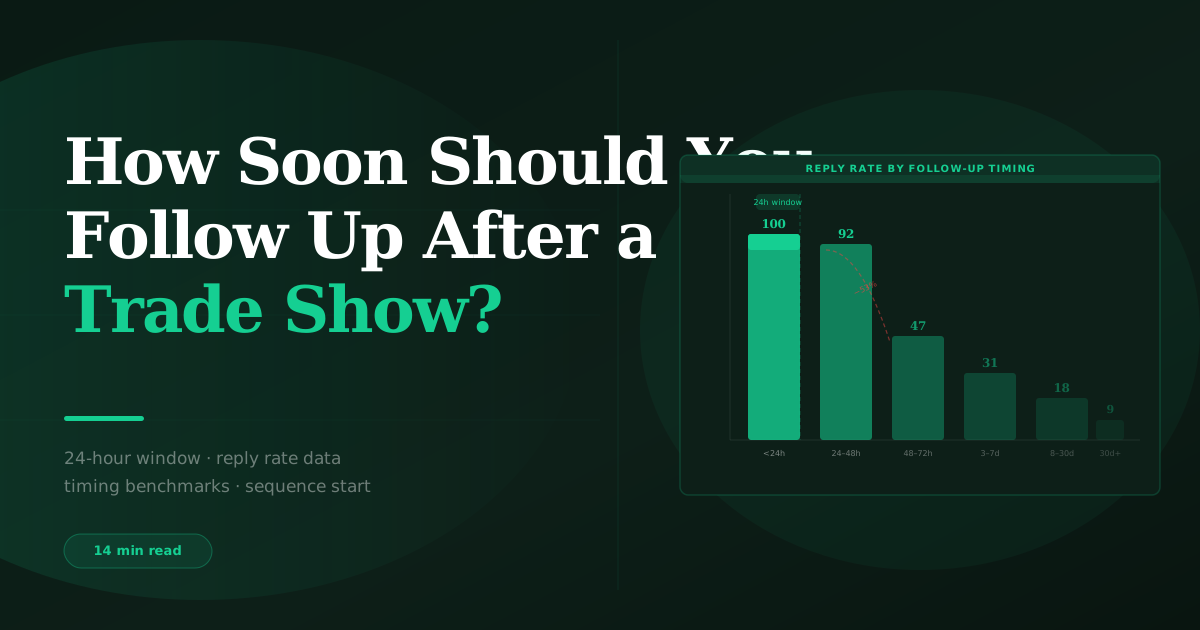
Follow up within 24 hours — ideally the same evening the show closes or the following morning. BoothMaven platform data from 2,400+ North American exhibitors across 2024–2026 shows that leads contacted within 24 hours of show close have a reply rate approximately three times higher than leads contacted 72 hours or more later. The window is not arbitrary: it is the period during which the visitor’s memory of the booth conversation is still strong enough to make a personalised follow-up feel like a continuation rather than a cold contact.
Most trade show follow-up advice says “follow up quickly.” Few give a specific number. When sales teams ask “how soon is soon enough?”, the honest answer has historically been an opinion dressed as data. This post gives you the actual data — from BoothMaven’s platform across 2,400+ exhibitors at North American shows — on how reply rates change by the hour and the day after a show closes.
The numbers are not surprising in direction but they are significant in magnitude. The difference between same-day follow-up and one-week follow-up is not a marginal improvement in reply rate. It is the difference between a lead list that generates pipeline and one that fills a CRM with contacts nobody calls.
For the complete follow-up system — templates, segmentation, CRM automation — see the cluster pillar: trade show follow-up: the complete guide.
What the Numbers Actually Show
BoothMaven’s analytics captures follow-up timing data automatically for customers whose CRM integrations are configured to track first contact date and first reply date. Across 2,400+ exhibitors at North American trade shows from 2024 through mid-2026, the following patterns emerged consistently across show sizes, industries, and buyer profiles.
BoothMaven Platform Data — Follow-Up Timing vs Reply Rate Index
Reply rates indexed to 100 at same-day follow-up baseline. Data from 2,400+ exhibitors at North American trade shows, 2024–2026. Hot and warm leads combined. Cold lead data excluded (cold leads are not time-sensitive on this curve — see Section 3).
| Follow-Up Timing | Reply Rate Index | Vs Baseline | Practical Implication |
|---|---|---|---|
| Same day (show evening) | 100 | Baseline | Maximum reply rate — conversation freshest |
| Within 24 hours | 92 | −8% | Effectively equivalent to same day |
| 48–72 hours | 47 | −53% | First major drop — weekend or travel often causes this delay |
| 4–7 days | 31 | −69% | Post-show inbox catchup has buried the booth memory |
| 8–14 days | 18 | −82% | Lead is functionally cold regardless of original temperature |
| 15+ days | 9 | −91% | Equivalent to cold outreach — no conversation memory advantage |
The most important breakpoint in this dataset is between the 24-hour window and the 48–72 hour window. Reply rates are effectively flat from same-day to within-24-hours — both are significantly better than anything after 48 hours. The 53-percentage-point drop between the 24-hour and 48–72-hour windows represents the memory decay threshold: within 24 hours, most leads still have a specific, retrievable memory of the booth conversation. After 72 hours, that memory has been overwritten by the post-show workload.
What causes the drop after 72 hours
Three mechanisms drive the reply rate degradation beyond 72 hours:
- Memory decay. A trade show visitor who met 30 exhibitors over three days returns to an inbox with 300 unread emails and a week of deferred work. By day four, the specific details of the booth conversation — the rep’s name, the feature discussed, the follow-up they promised — have faded into a general impression of the show rather than a specific memory of the interaction. A personalised email that would have felt like a welcomed continuation at 24 hours feels like a generic touch at 96 hours because the specificity no longer matches what the recipient can easily retrieve.
- Competing follow-ups. Every exhibitor at the show follows up. The batch of follow-up emails that arrives in the 72–96 hour window is typically the largest, because most exhibitors follow up when they return to the office after travel. A personalised follow-up in this window competes with 15–25 other exhibitor follow-ups for the same recipient’s attention.
- Context resolution. For hot leads with urgent timelines, a 72-hour delay means the urgency that existed at the booth may already have been partially resolved — by the visitor doing independent research, by a competitor who followed up the same day, or simply by the passage of time reducing the sense of immediacy.
How Timing Affects Hot, Warm, and Cold Leads Differently
The aggregate reply rate data above combines hot and warm leads. When segmented by lead temperature, the timing sensitivity differs significantly between the two groups.
Hot leads: most time-sensitive by far
For hot leads — contacts with active projects, meaningful decision influence, and near-term timelines — the reply rate drop between same-day follow-up and 72-hour follow-up is steeper than the aggregate data suggests. Hot leads at the time of booth capture have a specific urgency context: a deadline, an evaluation in progress, a project they need to resolve before a specific date. That urgency context depreciates rapidly. A hot lead contacted the evening of the show close is still in evaluation mode. The same lead contacted four days later has either already made progress with a competitor, has resolved the urgency through another route, or has deprioritised the project in the post-show workload catch-up.
For hot leads specifically: same-day or within-24-hour follow-up is not best practice — it is the minimum standard for meaningful conversion opportunity. A hot lead contacted after 72 hours should be treated as warm for follow-up sequencing purposes, because the original urgency that made them hot cannot be assumed to still exist.
Warm leads: moderately time-sensitive
Warm leads — evaluating but earlier stage, or with an influencer rather than decision-maker role — are less time-sensitive than hot leads, but the timing data still shows a meaningful difference within the first 48 hours compared to 72-plus. Warm leads benefit from a personalised first email within 48 hours that maintains the relationship momentum established at the booth. After 48 hours, warm leads can be enrolled in semi-automated sequences — the personalisation requirement is lower because the urgency is lower, but the speed still matters for establishing yourself as attentive and organised.
Cold leads: not time-sensitive on this curve
Cold leads — general browsers without near-term buying intent — are not meaningfully affected by follow-up timing within the first two weeks. Whether the first cold nurture email goes out on day 1 or day 7, the reply rate is low either way. Cold leads enter a 90-day nurture sequence that performs based on content quality and relevance, not on timing relative to the show. The effort investment in same-day cold lead follow-up is therefore not justified by incremental reply rate improvement — prioritise same-day effort for hot leads, and let automated sequences handle cold leads on their own schedule.
| Lead Temperature | Optimal First Contact | Timing Sensitivity | After 72h: Treat as… |
|---|---|---|---|
| 🔥 Hot | Same day or within 24h | Very high — urgency decays fast | Warm — reduce ask intensity |
| ⚡ Warm | Within 48h | Moderate — relationship momentum | Cold nurture sequence |
| ❄ Cold | Day 1–7 (automated) | Low — content matters more than timing | Continue sequence unchanged |
Why Most Exhibitors Miss the 24-Hour Window
Understanding the timing data is straightforward. Executing on it requires solving a specific operational problem that most exhibitors do not solve before the show: how to get leads into the CRM in real time so that the follow-up workflow can fire the same day rather than after a manual export and import step.
The three most common delay causes
- Batch data entry after the show. The most common cause of 72-hour-plus delays is that leads were captured on paper, in a spreadsheet, or in a system that requires a manual export — and that export and import happens when the team returns to the office. If your capture process requires any human hand-off step between capture and CRM, the 24-hour window is operationally out of reach for most of your leads.
- Organiser portal export delay. Many exhibitors rely on the organiser’s lead retrieval system, which provides a data export after the show closes. Organiser portals typically provide exports within 24–48 hours of show close — which means the earliest your CRM has the data is 24–48 hours after the last conversation. Before a single follow-up email is written, you are already outside the optimal window.
- Post-show processing queue. Even when data is available quickly, many sales teams schedule follow-up for Monday morning after a Friday show close, regardless of when the data arrived. This “Monday batch” approach consistently produces 72-hour-plus delays for shows that close Thursday or Friday — and 72 hours is where reply rates have already fallen by 53%.
The operational fix: same-day CRM sync
BoothMaven’s real-time CRM sync solves the data availability problem: leads captured at 2pm on the show floor are in HubSpot or Salesforce by 2:05pm. The CRM workflow fires immediately — hot leads trigger a rep task with the voice note transcript, warm leads trigger the first email in their sequence. The team does not need to return to the office to start follow-up. Hot lead follow-up can happen from the hotel room the evening the show closes, or from the airport the following morning, because the data is already there. See BoothMaven analytics and performance tracking for timing metrics.
When to Send — The Intraday Timing Data
Beyond the day-level timing data, BoothMaven’s platform also captures intraday send performance for first follow-up emails. Within the 24-hour window, the time of day the email arrives in the inbox produces measurable variation in open and reply rates.
Best performing send windows for first trade show follow-up emails, indexed to the best-performing slot. Data from the same North American exhibitor dataset, filtered for same-day and within-24h sends.
| Send Window (Recipient Time Zone) | Open Rate Index | Reply Rate Index | Notes |
|---|---|---|---|
| Tuesday–Thursday, 7:30–9:00am | 100 | 100 | Best window — before first meeting, inbox not yet buried |
| Tuesday–Thursday, 9:00–11:00am | 88 | 84 | Good — slightly lower as morning gets busy |
| Tuesday–Thursday, 1:00–3:00pm | 74 | 68 | Moderate — post-lunch window |
| Monday, any time | 61 | 54 | Lower — inbox flooded with weekend backlog |
| Friday, 12:00pm–5:00pm | 44 | 37 | Low — pre-weekend wind-down, inbox deprioritised |
| Weekend (Saturday–Sunday) | 38 | 28 | Avoid for B2B — visible when work resumes Monday, competes with Monday backlog |
The practical application: if a show closes on Thursday afternoon and you have hot leads ready to follow up, the best send time is Thursday evening (the recipient reviews before bed, or first thing Friday morning) or Friday 7:30–9:00am in their time zone. If Friday is not achievable, the next best window is Monday 7:30–9:00am — not Monday during business hours, when the inbox is already buried under the weekend catch-up.
Should You Follow Up During a Multi-Day Show?
For multi-day shows, the timing question becomes more nuanced: should hot leads from day one receive follow-up while the show is still running, or should all follow-up wait until after the show closes?
The case for during-show follow-up of day-one hot leads
A hot lead captured Monday morning at a three-day show is at peak memory freshness on Monday evening. By the time the show closes Wednesday afternoon, that lead is 48–54 hours old — already in the zone where reply rates have dropped by more than half compared to same-day follow-up. Sending a personalised follow-up email Monday evening to a hot lead captured Monday morning gets the email in front of the recipient at the point of maximum memory freshness, two full days earlier than waiting for the show to close.
This requires real-time CRM sync — if your leads are not in the CRM until you return from the show, during-show follow-up is not possible. With BoothMaven’s real-time sync, the lead is in HubSpot or Salesforce within minutes of capture, the voice note transcript is attached, and the rep task fires immediately. The follow-up can be written from the hotel room the first evening of a three-day show.
Practical protocol for multi-day shows
At the end of each show day, the booth manager or sales lead reviews the day’s hot leads in the CRM — the BoothMaven analytics dashboard shows all that day’s captures by temperature. Hot leads from that day receive personalised follow-up that evening. Warm leads from that day are enrolled in their automated sequence with a send time of the following morning in their time zone. Cold leads from that day are enrolled in the cold nurture sequence automatically by the CRM workflow. By the time the show closes on the final day, leads from days one and two are already in active follow-up sequences, and only the final day’s captures need same-evening or next-morning follow-up.
A cybersecurity exhibitor at a major US technology conference began following up on hot leads the same evening they were captured, for the first time at this particular show. By the end of day one, their rep had sent personalised follow-up emails to 11 hot leads captured that day. By the evening of day two, three of those 11 had already replied — one requesting a demo call the following week, one asking for a specific technical comparison, and one connecting them directly with the CISO who would make the final decision. All three replies came before the show had even closed. In previous years, following up on the Monday after the Friday show close, they had generated zero replies from the same show’s hot leads before the following week’s end.
How to Track Follow-Up Timing in Your CRM
Knowing the industry data is useful. Knowing your own data — your team’s average time from show capture to first follow-up, by show type and by lead temperature — is more useful. This is data you can act on directly, and it is available from your CRM if you configure the right tracking fields.
Required CRM fields for follow-up timing analytics
Configure three custom fields in HubSpot or Salesforce: Capture Date (populated automatically by BoothMaven at sync time), First Follow-Up Date (populated when the first outbound email or call is logged against the contact), and First Reply Date (populated when the first inbound response is received). The gap between Capture Date and First Follow-Up Date is your follow-up speed metric. The gap between First Follow-Up Date and First Reply Date, segmented by follow-up speed bucket, reproduces the timing vs reply rate relationship from this post in your own data.
Once these fields are in place, build a simple dashboard in your CRM that shows: average follow-up speed by show (so you can compare how quickly you moved after different shows), average follow-up speed by lead temperature (to confirm hot leads are getting faster follow-up than warm leads), and reply rate by follow-up speed bucket (to see your own version of the timing curve). Run this report after each show and share it with the sales team. The first time a rep sees that their 5-day follow-up average correlates with a 22% reply rate versus their colleague’s 1-day average correlating with a 71% reply rate, follow-up timing discipline improves immediately.
USA: The 24-hour standard applies universally. The intraday timing data (Tuesday–Thursday, 7:30–9:00am in recipient time zone) is particularly important for US shows with multi-time-zone attendee bases — a show in Chicago with attendees from both Eastern and Pacific time zones means “9:00am” send time needs to be calibrated per recipient, not per show. Configure your CRM to schedule sends in the recipient’s local time zone based on their state field.
Canada: Same 24-hour standard. Two Canada-specific notes: (1) Canadian public sector contacts (federal and provincial government) often have compressed summer hours (June–August) with reduced inbox responsiveness — build in slightly longer reply windows for public sector contacts captured at summer shows. (2) For Quebec and bilingual contacts, if the first follow-up email is in English only and the contact’s primary language is French, reply rates are lower than for bilingual or French-first subject lines. A bilingual subject line costs twenty seconds and improves open rates measurably for Francophone recipients.
Same-day and within-24-hour follow-up produce effectively equivalent reply rates — both are approximately 3× higher than 72-hour follow-up. The practical target is same evening or first thing the next morning, not “when I get back to the office.”
Hot leads become warm leads after 72 hours. The urgency context that made a lead hot at the booth depreciates rapidly. A hot lead contacted four days later should be treated as warm for follow-up purposes, because the original urgency can no longer be assumed.
Real-time CRM sync is the operational prerequisite for 24-hour follow-up. If leads are not in your CRM until you return from the show, the 24-hour window is not achievable for most leads. BoothMaven’s real-time sync solves this by putting captures in HubSpot or Salesforce within minutes — enabling follow-up from the hotel room on the evening of capture.
Frequently Asked Questions
USA: The 24-hour standard and intraday timing recommendations apply universally. For US shows with multi-time-zone attendees, configure your CRM to send follow-up emails in the recipient’s local time zone based on their state field. Sending “9:00am” in the sender’s time zone can mean 6:00am or 12:00pm for recipients in other zones — a significant open rate difference.
Canada: Same 24-hour timing standard. Specific considerations: (1) Canadian public sector contacts often have compressed summer hours — allow slightly longer reply windows June–August. (2) For Quebec Francophone contacts, a bilingual or French-language subject line measurably improves open rates. (3) CASL compliance — implied consent from a trade show interaction is time-limited; track consent dates in your CRM for Canadian contacts.
Conclusion
The data answers the question directly: follow up within 24 hours. The same-day-to-24-hour window produces reply rates approximately three times higher than the 72-hour-plus window. Hot leads contacted after 72 hours should be treated as warm. Cold leads are not time-sensitive on this scale.
The operational implication is equally direct: same-day CRM sync is the prerequisite. Without it, the 24-hour window is not achievable for most leads. With it, follow-up can happen from wherever the team is — hotel room, airport lounge, the car back from the venue — because the data is already waiting in the CRM with the voice note attached.
Every hour of delay after the 24-hour window costs reply rate. The data quantifies exactly how much. Whether that cost is worth the delay is a decision each exhibitor makes implicitly — but now with numbers rather than assumptions.