
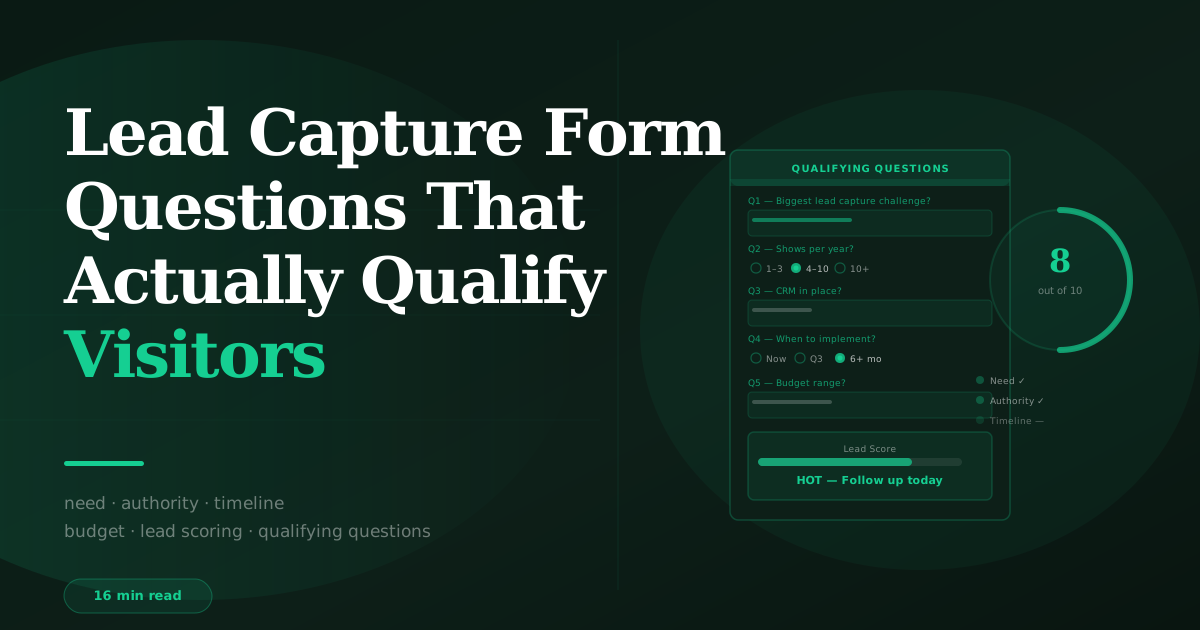
Lead Capture Form Questions That Actually Qualify Trade Show Visitors
BoothMaven Editorial Team·July 14, 2026·23 min read·CL-35 Spoke
The three qualifying questions that reliably separate buyers from browsers at a trade show are: “What’s prompting you to look at this now?” (identifies urgency), “Who else is involved in evaluating options?” (identifies decision authority), and “Are you looking to move forward before [specific date]?” (identifies timeline). Ask them conversationally within the first two minutes of every interaction, record the answers in your lead capture app, and use the responses to set a lead temperature before the visitor leaves your area.
A badge scan captures a name and an email address. A badge scan with the right qualifying questions captures a pipeline-ready lead with a known need, a known decision structure, and a known timeline. The technology is the same. The outcome is completely different. The difference is two minutes of structured conversation and three well-chosen questions.
This guide covers the theory behind qualifying questions at trade shows — why they work, how many to ask, and how to embed them naturally in conversation — and then gives you a bank of 27 field-tested questions sorted by buying stage, industry, and conversation context. You can select your three questions for each show from this bank, load them into your lead capture app, and have your team briefed and role-played in twenty minutes.
For the full lead capture context — how qualifying questions fit within a complete capture system — see: how to capture leads at a trade show: the complete guide.
The Difference Between a Lead List and a Sales Pipeline
The most common trade show reporting metric is total leads captured — the number of badge scans, card scans, and form submissions that came out of the show. It is also the least useful metric for evaluating trade show performance. A show that produces 400 badge scans with no qualification data is not four times better than a show that produces 100 badge scans with three qualifying data points and a lead temperature on each.
The reason is simple: without qualification data, your sales team has no way to prioritise follow-up. When they open the CRM on Monday morning and see 400 contacts with identical records — name, company, email — they start at the top of the list and work alphabetically. The hot lead who told your rep they have a board presentation next month and need a decision by Thursday is in the same queue as the student who took a product brochure. Neither the student nor the hot lead gets the right treatment.
Qualification data — specifically, a lead temperature set by the booth rep who had the conversation — is what turns a list into a prioritised pipeline. The qualifying questions are the mechanism that generates enough information for the rep to set that temperature accurately.
Across BoothMaven customers tracking trade show lead-to-opportunity conversion across North American shows, leads where the booth rep set a lead temperature based on qualifying question responses converted to sales opportunities at 3.4× the rate of leads where only contact details were captured. The temperature-set leads also had a 62% shorter average sales cycle from first contact to closed deal. The qualification data did not just improve prioritisation — it gave sales reps enough context to personalise the first follow-up, which reduced the number of follow-up touches required to reach a meaningful sales conversation.
What to Qualify For — The Three Axes of Trade Show Lead Scoring
Every qualifying question should probe one of three dimensions. These three dimensions — need, authority, and timeline — are sufficient to set a lead temperature accurately and to give a sales rep enough context for a personalised first follow-up.
Axis 1 — Need: Do they have a genuine problem you can solve?
Need qualification identifies whether the visitor is dealing with a real, active problem that your product or service addresses, or whether they are browsing out of general interest. The distinction matters because a visitor with an active problem has a reason to move forward. A visitor who is “just curious” does not have a buying trigger — and without a buying trigger, no amount of follow-up converts them on a short timeline.
Need questions probe: what is the current situation (what tool, process, or supplier are they using now), what is not working about it (the pain), and what prompted them to be looking at alternatives now (the trigger). The trigger is the most important signal — an urgent trigger (a contract is expiring, a system failed, a new budget has been approved) correlates strongly with short-timeline buying behaviour.
Axis 2 — Authority: Can they or will they be part of the decision?
Authority qualification at a trade show is more nuanced than the classic BANT (Budget, Authority, Need, Timeline) framework suggests. The goal is not to identify whether this person is the sole decision-maker — at most companies above a certain size, no single person is. The goal is to identify where they sit in the decision-making process and whether they have meaningful influence over the outcome.
A useful authority question at a trade show does not ask “are you the decision-maker?” — which produces defensive answers. It asks “who else is typically involved when your team evaluates something like this?” This question identifies the decision structure without making the visitor feel evaluated, and it gives you information about whether you are speaking to the economic buyer, the technical evaluator, the champion, or the end user.
Axis 3 — Timeline: When do they need to make a decision?
Timeline qualification identifies whether the visitor is early-stage researching (twelve months or more out), actively evaluating (three to six months), or close to decision (within weeks or by a specific date). This signal, combined with need and authority, is what determines whether a lead is hot, warm, or cold.
A visitor with a clear trigger, meaningful decision authority or influence, and a decision deadline within the next quarter is a hot lead by definition. A visitor with a vague general interest, no clear authority, and no timeline is cold. Everything in between is warm. The three qualifying questions — one per axis — are all you need to make that classification reliably.
27 Field-Tested Qualifying Questions for Trade Show Booths
The questions below are organised by axis (need, authority, timeline) and then by conversation context. Select one question from each axis for your specific show and audience — no more than three total. Load them into your BoothMaven qualifying questions screen before the show and brief your team on how to weave them into conversation rather than read them from the screen.
Need questions — identify the trigger and the problem
| # | Question | What it surfaces | Best context |
|---|---|---|---|
| N1 | “What’s prompting you to look at this now — is there a specific project or situation driving it?” | Urgency trigger, active vs passive interest | General B2B — works in almost all show contexts |
| N2 | “What does your current setup look like for [this problem area]?” | Incumbent solution, switching trigger | When replacing an existing tool or process |
| N3 | “What’s the biggest frustration with how you’re handling this today?” | Primary pain point, emotional urgency | When visitor volunteers they have a current process |
| N4 | “What would the ideal outcome look like if you found the right solution?” | Success criteria, unmet need | Early-stage evaluators, greenfield situations |
| N5 | “What’s the business impact if this problem isn’t resolved in the next six months?” | Cost of inaction, priority relative to other projects | Enterprise and strategic sale contexts |
| N6 | “Have you evaluated other options — what made you keep looking?” | Competitive landscape, unsatisfied evaluation so far | Visitors who mention they’ve been looking for a while |
| N7 | “What’s changed recently that made this a priority?” | Triggering event — budget, leadership change, contract expiry | When visitor mentions the timing feels right |
| N8 | “How big a challenge is this on a scale of things your team is dealing with right now?” | Priority relative to competing initiatives | When need is clear but urgency is uncertain |
| N9 | “What would it take for this to get budget approved at your organisation?” | Budget process, approval chain, internal selling required | Mid-market and enterprise with complex procurement |
Authority questions — identify the decision structure
| # | Question | What it surfaces | Best context |
|---|---|---|---|
| A1 | “Who else is typically involved when your team evaluates something like this?” | Decision-making structure, stakeholders | Universal — works in all B2B contexts |
| A2 | “Are you leading the evaluation, or is there a team you’re part of?” | Visitor’s role in the process (champion vs evaluator vs buyer) | When you can’t tell from their job title |
| A3 | “Does a decision like this go through a procurement process, or can your team move directly?” | Procurement friction, likely sales cycle length | Government, large enterprise, healthcare |
| A4 | “Is this the kind of decision your team can make, or does it need to go upward?” | Budget authority level, escalation required | Mid-level managers, department heads |
| A5 | “Who would you bring this back to after the show?” | Next stakeholder in the chain, follow-up routing | When you suspect the visitor is a champion but not the buyer |
| A6 | “Has your leadership already given this a green light to evaluate, or are you still making the case?” | Level of internal sponsorship, early vs late stage | When need is clear but organisational buy-in is uncertain |
| A7 | “What department would this typically sit in at your company?” | Who owns the budget, likely approval chain | When company is large enough to have unclear ownership |
| A8 | “Are you the one who would sign off on something like this, or does that happen elsewhere?” | Economic buyer status — direct but inoffensive phrasing | SMB and mid-market where single decision-maker is common |
| A9 | “Is this a solo project or are there other teams whose buy-in you’d need?” | Cross-functional complexity, timeline implications | Operational and workflow tools used across departments |
Timeline questions — identify urgency and decision window
| # | Question | What it surfaces | Best context |
|---|---|---|---|
| T1 | “Are you looking to have something in place before [specific date or event]?” | Hard deadline, decision urgency | When visitor mentions an upcoming project, season, or event |
| T2 | “What’s the rough timeframe you’re working with — a few months, by end of year?” | General timeline without a hard deadline | Universal starting point for timeline qualification |
| T3 | “Is this something you’d want to resolve before your next fiscal year starts?” | Fiscal year budget cycle, urgency | Large enterprise with defined fiscal year buying |
| T4 | “Do you have budget allocated for this already, or is that part of the planning process?” | Budget existence and cycle stage | When timeline and budget status are unclear |
| T5 | “If the right solution showed up today, how quickly could your team move?” | Speed-to-decision potential, procurement friction | When need and authority are strong but pace is uncertain |
| T6 | “Are there any hard constraints on timing — contracts ending, go-live dates, events?” | External deadline driving urgency | When you suspect there is a trigger event you have not identified yet |
| T7 | “Is this something your team is actively prioritising this quarter?” | Relative priority vs other projects | When the need is real but timing feels uncertain |
| T8 | “Would a decision in the next ninety days be realistic, or is this more of a longer horizon?” | Short-term vs long-cycle pipeline segmentation | Universal — good for routing hot vs warm vs cold |
| T9 | “Is there a specific event or launch that this needs to be ready for?” | Event-driven deadline (product launch, trade show, season) | Retail, events, seasonal businesses |
How to Choose the Right Three Questions for Each Show
Not every question from the bank above is appropriate for every show. The right set depends on your product, your buyer’s typical profile at this specific show, the likely buying stage of most attendees, and the conversational norms in this industry. Here is a selection framework for the most common scenarios.
For a general B2B product at a major trade show (CES, HIMSS, Dreamforce)
At major shows where attendees range from early-stage researchers to active buyers: N1 (“What’s prompting you to look at this now?”) + A1 (“Who else is typically involved?”) + T8 (“Would a decision in the next ninety days be realistic?”). This combination covers the three axes broadly and works across buying stages. It produces reliable lead temperature signals without feeling like an interrogation.
For a specialist product at a niche industry show
At niche shows where most visitors have a genuine need but varying urgency: N3 (“What’s the biggest frustration with how you’re handling this today?”) + A5 (“Who would you bring this back to after the show?”) + T6 (“Are there any hard constraints on timing?”). N3 works well because visitors at specialist shows are comfortable discussing their operational problems in detail — they are there specifically because they have the problem your product solves.
For an SMB-focused product at a small regional show
At smaller shows with mostly SMB attendees where the buyer and decision-maker are often the same person: N7 (“What’s changed recently that made this a priority?”) + A8 (“Are you the one who would sign off on this?”) + T5 (“If the right solution showed up today, how quickly could you move?”). A8 works well with SMB audiences where the direct question about decision authority is appropriate and expected — unlike enterprise contexts where it can feel presumptuous.
USA regional shows: At shows in sectors with strong buying urgency (manufacturing, construction, food and beverage) in the US, timeline questions that reference fiscal year or seasonal cycles perform well. “Before your busy season?” or “Before your next annual budget cycle?” are natural and relevant.
Canadian shows: Many Canadian public sector and large enterprise buyers operate on an April–March fiscal year. The fiscal year timeline question (T3) is particularly effective at Canadian shows serving government or regulated industries — October to February is the peak budget-commitment window. At Canadian SMB shows, the question set for SMB above works without modification.
How to Ask Qualifying Questions Without Making Visitors Feel Interrogated
The most common mistake in trade show qualification is asking questions sequentially and mechanically — like reading from a list. Visitors notice this and disengage. Effective qualifying happens inside a natural conversation where the questions are woven into the discussion of the visitor’s situation rather than appended to it.
The conversation arc that works
The most reliable conversation structure at a trade show booth is: open with genuine curiosity about their situation → listen to their response → ask one clarifying question that is also a qualifying question → listen again → move naturally to the next qualifying question as a follow-up to what they said, not as the next item on your list. Each qualifying question should feel like the obvious next thing to ask given what the visitor just said, not like you are working through a script.
For example: Visitor says “We’re looking at how we capture leads at trade shows — our current process isn’t working well.” Rep responds: “That’s a common challenge. What part specifically is breaking down for you?” (N3 — casual, curious, genuinely following from what was said). Visitor explains. Rep: “Sounds like timing is a big part of it. Is this something you’re trying to fix before your next show?” (T1/T6 — natural follow-on to the timing element the visitor raised).
The structured vs open question balance
In the app, qualifying questions are typically set up as structured responses — dropdown options like “Active project / Exploring / Just looking” — because structured responses are easier to log quickly and produce consistent data for CRM filtering. But the question you ask verbally should be open, not closed. Ask “What’s prompting you to look at this now?” and then select the closest matching dropdown option based on what the visitor says. Do not ask “Are you in an active project, exploring, or just looking?” — that is a structured response masquerading as a question and it produces uncomfortable, abbreviated answers.
What to do when the visitor does not answer
Some visitors deflect qualifying questions — “I’m just having a look” or “I’m not sure yet” are common responses that block further qualification. Do not push. Accept the answer, record it as the closest dropdown option (“Exploring”), set the temperature to warm, and move on. A deflecting visitor who is genuinely browsing will not convert regardless of how hard you qualify. A deflecting visitor who is actually a hot lead but is not yet comfortable sharing information will re-engage when your follow-up email arrives and is personal and relevant — at which point the qualification happens in the sales conversation, not on the show floor.
From Conversation to CRM Record: The Qualification Workflow
The BoothMaven qualification workflow is designed to fit inside a two-minute booth interaction without interrupting the conversation. Here is the exact sequence:
Scan the badge or card first. This opens the contact record and the qualifying questions screen in the app. The screen is now ready to receive answers without the rep having to navigate to a different part of the app mid-conversation.
Ask the first qualifying question verbally and select the matching answer on screen. The visitor is talking; the rep selects the closest dropdown option based on what they hear. This looks the same as taking a note to the visitor — it does not interrupt the conversation.
Continue the conversation naturally to the second and third questions. Each question follows from what the visitor just said. Select answers as responses are given. The three questions typically complete in the natural flow of a two-minute product conversation.
Set the lead temperature before the visitor leaves. The rep makes the hot / warm / cold call based on everything heard in the conversation — not just the three structured answers. The temperature is the rep’s judgment, informed by the qualifying data. Set it before the visitor walks away.
Record a voice note within 60 seconds of the interaction ending. The structured answers capture three data points. The voice note captures everything else — the specific words the visitor used, the competitor they mentioned, the product feature they got excited about, the hesitation they expressed. This context is what makes the first follow-up email personal.
Qualifying Questions by Industry — Pre-Built Sets
The questions below are pre-built sets for the most common BoothMaven customer industries. Each set uses the correct vocabulary for the industry (see the vocabulary rules in the writer’s guide) and selects the three questions most appropriate for that audience’s typical buying behaviour.
Healthcare / Medical conferences (congress vocabulary — never “trade show”)
At medical congresses and healthcare conferences, the buyer is often a clinical or procurement lead with a long evaluation cycle and compliance requirements. Questions: N5 (“What’s the business impact if this isn’t resolved in the next six months?”) + A3 (“Does a decision like this go through a procurement process?”) + T3 (“Is this something you’d want resolved before your next fiscal year?”). These questions are calibrated for healthcare’s long procurement timelines and formal evaluation processes.
SaaS / Technology events (event and conference vocabulary)
At tech events, buyers are often technically sophisticated and self-directed in their evaluation. Questions: N2 (“What does your current setup look like for this?”) + A2 (“Are you leading the evaluation?”) + T8 (“Would a decision in the next ninety days be realistic?”). N2 opens a technically rich conversation. A2 identifies whether the visitor is a champion, evaluator, or decision-maker without the social awkwardness of asking directly about budget authority.
Manufacturing / Industrial exhibitions
At manufacturing shows, buyers often have a specific operational problem and a clear idea of what they need. Questions: N3 (“What’s the biggest frustration with your current setup?”) + A4 (“Is this the kind of decision your team can make?”) + T6 (“Are there any hard constraints on timing — contracts, go-live dates?”). N3 produces rich operational detail. T6 often uncovers external deadlines the visitor had not volunteered.
Financial services / Fintech conferences (conference vocabulary — never “trade show”)
At financial services conferences, compliance and regulatory considerations heavily influence evaluation timelines. Questions: N9 (“What would it take for this to get budget approved?”) + A6 (“Has your leadership given this a green light?”) + T3 (“Is this something you’d want resolved before your next fiscal year?”). N9 immediately surfaces the compliance and procurement structure that will govern the sale.
Tailoring Qualifying Questions to the Visitor’s Role — A Persona Guide
The best qualifying question set for a CFO is different from the best set for a VP of Engineering, which is different again from the best set for a Procurement Manager. The same three-axes structure applies — need, authority, timeline — but the specific questions within each axis should be selected based on what each persona type is most likely to respond to honestly and completely.
For C-suite and senior leadership visitors (CEO, CFO, COO, CMO)
Senior leaders are time-pressed and outcome-oriented. They respond poorly to technical or operational qualifying questions and well to business impact questions. The best question set for a senior leader: N5 (“What’s the business impact if this problem isn’t resolved in the next six months?”) + A6 (“Has your leadership already given this a green light?”) — which for a C-suite visitor means asking about board or investor alignment rather than internal leadership — + T5 (“If the right solution showed up today, how quickly could your team move?”). Avoid questions that seem to question their authority (A4: “Is this the kind of decision your team can make?”) — for a C-suite visitor, this can land as insulting rather than qualifying.
For VP and Director-level visitors (VP Sales, Director of Operations, etc.)
VP and Director-level visitors are typically the decision-makers or strong champions for mid-market purchases. They have budget visibility and can usually tell you both the budget range and the approval process. The best question set: N1 (“What’s prompting you to look at this now?”) + A4 (“Is this the kind of decision your team can make?”) + T2 (“What’s the rough timeframe you’re working with?”). These visitors appreciate directness and are comfortable with qualification — they do it themselves when evaluating vendors.
For Manager and Team Lead visitors
Managers are often the primary evaluators who will recommend a solution upward. They know the problem deeply but may have limited budget visibility. The best question set: N3 (“What’s the biggest frustration with how you’re handling this today?”) + A5 (“Who would you bring this back to after the show?”) + T7 (“Is this something your team is actively prioritising this quarter?”). A5 is particularly valuable for managers — their answer tells you who the economic buyer is and whether you need to engage them directly.
For Individual Contributor and Technical visitors
Technical visitors (engineers, analysts, developers) are often early-stage researchers or champions who need to convince a manager or director. They rarely have direct budget authority but can be powerful internal advocates. The best question set: N2 (“What does your current setup look like for this?”) + A2 (“Are you leading the evaluation?”) + T8 (“Would a decision in the next ninety days be realistic?”). A2 cleanly identifies whether the visitor is a solo evaluator or part of a larger evaluation team without asking about budget authority, which technical visitors often do not know.
| Visitor Persona | Need Question | Authority Question | Timeline Question | Typical Temp |
|---|---|---|---|---|
| C-Suite (CEO/CFO/CMO) | N5 — Business impact | A6 — Leadership buy-in | T5 — Speed if right fit | Hot or Cold (rarely Warm) |
| VP / Director | N1 — Current prompt | A4 — Decision authority | T2 — General timeframe | Best conversion profile |
| Manager / Team Lead | N3 — Frustration today | A5 — Who they brief post-show | T7 — Active this quarter? | Warm — needs champion |
| IC / Technical | N2 — Current setup | A2 — Leading evaluation? | T8 — 90-day realistic? | Warm — long cycle |
A SaaS exhibitor at a major US technology conference changed their qualifying question set for one show cycle — from three generic questions about “interest level, company size, and use case” to the three-axis framework (N1, A1, T8). In the following quarter, their trade show lead-to-opportunity conversion rate increased from 8% to 27%. Their sales director’s explanation: “The old questions told us what they did. The new questions told us whether they were buying. Turns out, about 30% of our show leads were actually buying. We just didn’t know which 30%.”
Three questions, three axes. One need question, one authority question, one timeline question. These three data points are sufficient to set a lead temperature accurately and give a sales rep enough context for a personalised first follow-up.
Ask open questions verbally, record structured answers in the app. “What’s prompting you to look at this now?” produces better answers than “Are you in an active project?” Ask openly, select the closest dropdown option based on what you hear.
The voice note carries everything the structured questions miss. Three dropdown answers capture three data points. A 30-second voice note captures the competitor they named, the feature they got excited about, and the reason you rated them hot. Both are required.
Frequently Asked Questions
Canada: Many Canadian public sector and large enterprise organisations follow an April–March fiscal year, making October to February the peak urgency window. At Canadian shows in regulated industries, questions that surface the procurement process early (A3: “Does a decision like this go through a procurement process?”) save significant time by identifying long-cycle government or institutional procurement situations before investing follow-up resources.
Conclusion
Qualifying questions are the mechanism that transforms a contact list into a sales pipeline. Three well-chosen questions — one probing need, one probing authority, one probing timeline — give a sales rep enough information to know whether a lead deserves a same-day phone call, a personalised nurture sequence, or a long-cycle drip campaign. Without them, your sales team faces 200 identical CRM records on Monday morning and has no rational basis for prioritisation.
Choose your three questions from the bank above before each show. Load them into your lead capture app. Brief your team on how to weave them into conversation rather than read them as a list. And record a voice note after every interaction to capture the context that structured answers cannot hold. Two minutes of structured conversation per visitor is the difference between a show that adds names to a database and a show that fills a pipeline.
Lorem ipsum dolor sit amet, consectetur adipiscing elit. Ut elit tellus, luctus nec ullamcorper mattis, pulvinar dapibus leo.