

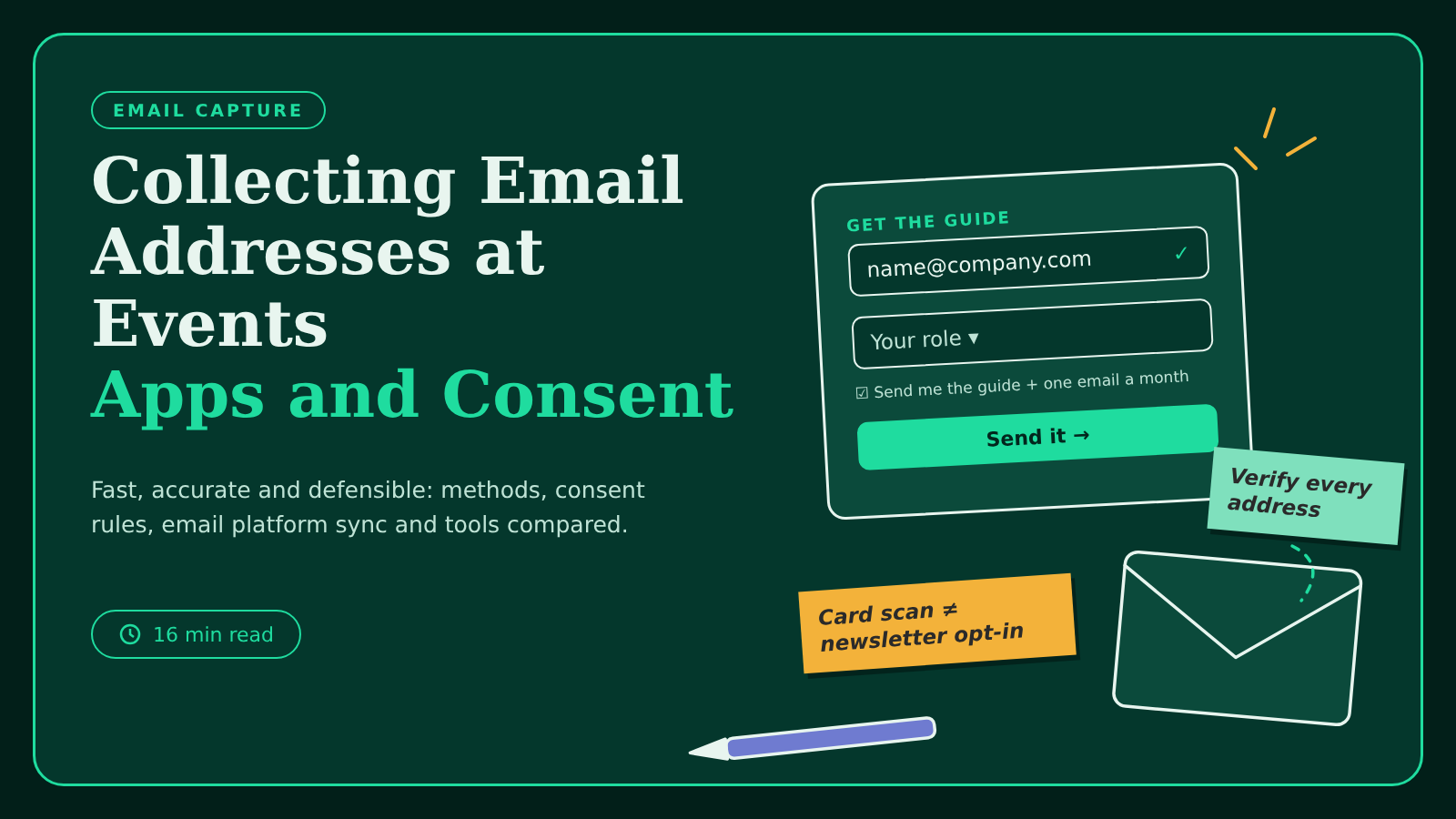
Collecting an email address at an event takes seconds. Keeping it usable takes more. A third of the addresses typed on a tablet may have a typo, a visitor who handed over a business card may not have agreed to a newsletter, and the email platform you plan to use may refuse the list. This guide covers how to collect emails at events in ways that stay clean and defensible, which methods and apps fit which situation, and where consent rules and platform rules differ.
It is written for field marketers, event marketers, marketing operations and booth sales teams who need an email list that survives contact with an email platform and a spam filter. It differs from our ten-tool lead capture comparison: that page compares platforms, and this one is about the email address itself, from the moment it is typed to the first send. We make BoothMaven, so we are not neutral, and we say where simple tools are enough. This is not legal advice, and rules differ by country.Seven ways to collect email addresses at an event
To collect emails at events well, start with the method. Booths collect emails in several ways, and the method decides how accurate the address is and how strong the consent is. Compare them before you pick an app.| Method | How it works | Speed | Accuracy | Consent strength |
|---|---|---|---|---|
| Tablet or phone form | The visitor types their own email into a short form | About 15 to 30 seconds | Good if typed by the visitor; typos still happen | Strong, if the form shows a clear consent line |
| QR code to a form | The visitor scans a code and fills a form on their phone | About 20 to 40 seconds | Good; the visitor sees what they type | Strong, if the page carries consent wording. See QR codes for lead capture |
| Badge scan | The rep scans the visitor’s badge | A few seconds | Depends on the badge; may lack an email | Varies by show terms. |
| Business card scan | The rep scans or types from a card | A few seconds to a minute | OCR errors are common. See card scanners | Weak for marketing: a card shows willingness to talk |
| Sweepstake or giveaway entry | A form, kiosk or fishbowl in exchange for a prize | Fast | Mixed; some use throwaway addresses | Must state the purpose clearly |
| Text to join | The visitor texts a keyword and replies with an email | Slow | Good | Strong, but friction is high |
| Digital card share-back | The visitor shares details from your card page | A few seconds | Good | Strong when the visitor chooses to share. |
Signup speed: the shortest form that still works
Speed decides how many people finish. A visitor at a busy booth will give you a few seconds, not a minute. Each extra field costs completions, so ask for what you need to follow up, and nothing else.- Email first. It is the one field you cannot do without.
- Name next. First and last in one field is faster to type on a phone.
- One qualifier, such as role or interest, with tap answers rather than typing. See qualifying questions that work.
- A consent line, with a checkbox where the law or your email platform requires one.
- Nothing else. Company and phone can come from enrichment or a later step.
Accuracy: typos, fake addresses and verification
An email address that cannot receive mail costs you twice: you lose the lead, and the bounce counts against your sending reputation. Four things go wrong at events. Visitors mistype on a small keyboard. Reps mistype from a card. Some visitors enter a throwaway address to get a prize. And badge or card data may be out of date.- Verify at capture or straight after. A verifier checks the format, the domain and whether the mailbox exists. BoothMaven’s email verifier is a Business-tier feature, and it uses a third-party verification service, so results are indicative.
- Ask for the address twice only when stakes are high. It adds friction, so use it for prize entries, not every lead.
- Send a confirmation email. A double opt-in email proves the address works and that the person wants to hear from you.
- Watch your bounce rate on the first send. A high rate means a cleaning step was missing.
The consent gap: what the law says and what your email platform allows
This is where many event lists fail, and the reason is a gap between two sets of rules. The law varies by country, and email platforms add their own rules, often stricter.| Source of the rule | What it generally says about event contacts | What it means for you |
|---|---|---|
| GDPR and similar laws | Marketing generally needs a lawful basis, and consent must be provable. Handing over a card or being scanned is not the same as agreeing to marketing | Use a clear opt-in or a documented alternative lawful basis, and keep proof |
| CASL (Canada) | Government guidance gives the example that disclosing an email address verbally or in writing, such as by giving a business card at a trade show, can create implied consent, which lasts two years and must be provable | Implied consent has conditions and a time limit. Keep records |
| CAN-SPAM (US) | Does not require opt-in for most commercial email, but requires an accurate sender, a physical address and an unsubscribe | Meets the legal minimum, and platform rules may still apply |
| Email platform policies | Some state that cards collected at events are not valid opt-ins and require proof of consent. ActiveCampaign’s help centre, for example, says business cards alone are not valid opt-ins | Your platform may suspend you for a list the law would allow. Read its policy |
Email platform integration: native, Zapier or export
An email capture app for events is only useful if the address reaches the tool where you will email it. Three routes exist. A native sync sends the contact to your CRM or email platform automatically. A Zapier or webhook route does the same through a connector, and an export moves a file by hand. Each has trade-offs in speed, control and cost.- Native: fastest and simplest. BoothMaven syncs to HubSpot and Salesforce on Essential and Business.
- Zapier or webhook: flexible, and the route to other email platforms.
- Export: a CSV works for a small list. It is slow, and it loses source and consent data unless you add columns.
Offline capture: collecting emails when the venue network fails
Venue networks fail at the worst moment. A form that needs a live connection loses submissions silently, and visitors will not wait. Look for apps that store submissions on the device and sync when the connection returns, and test it. Switch to airplane mode, capture five addresses, reconnect and check that all five arrive. BoothMaven works offline on every plan, and enrichment and sync resume when the device reconnects. See offline mode and our offline FAQ. Offline capture has a consent angle too. The notice at the booth must be visible whether or not the device is online, and any consent checkbox must be saved with the record. Ask the vendor how consent is stored in an offline submission.Apps to collect email addresses at events, by type
| Type | Examples | Strengths | Watch-outs |
|---|---|---|---|
| General form tools | Google Forms, Typeform and similar | Cheap or free; flexible; familiar | Need a connection; no scanning; no rep attribution unless you add a field; you build the sync. |
| Email platform form apps | Apps such as ActiveCampaign’s Forms for iPad, per ActiveCampaign’s help centre | Feed your email platform directly; built-in consent options | Tied to one platform; no CRM or badge scanning |
| Event lead capture apps | BoothMaven, Popl, Blinq, Zuant, Mobly | Scanning, cards, notes, offline, CRM sync and qualification in one record | Cost; setup; some do not publish prices |
| Kiosk and giveaway tools | Photo booth and sweepstake apps. | Draw a crowd; collect emails in exchange for a prize | Lower lead quality; consent must be clear |
Where each lead capture app fits email collection
Among the event tools we researched, the differences that matter for an email capture app for events are small and specific. BoothMaven offers custom qualifying forms, offline capture on every plan, an email verifier on Business, email sequences with templates and CRM sync on Essential and Business, and it does not publish a consent-management product, so teams with strict consent needs may want more. Zuant puts consent first through Zuant Vault and a QR check-in flow, though reviewers mention manual sync. Popl and Blinq capture a visitor’s details when the visitor shares back from a card, which is a strong consent signal. Mobly adds email and SMS follow-up from the booth, and B2Brain focuses on voice notes and meetings. If your main risk is consent, ask each vendor how it records the wording and the time of consent and whether it can store a checkbox. If your main risk is accuracy, ask about verification. If your main risk is speed, test the form on a phone. See BoothMaven vs Zuant, Popl alternatives and the alternatives hub. For the event tools we researched, here is how each handles the four things that matter for email capture. These are the vendors’ own claims, so test each one with the plan in this guide.| Tool | Form and consent | Offline | Email platform or CRM | Watch-out |
|---|---|---|---|---|
| BoothMaven | Custom qualifying questions (5, 20 or unlimited by tier); you add the consent wording | Offline on every plan | HubSpot and Salesforce on Essential and Business; Zapier; email verifier on Business | No consent-management product |
| Popl | Lead capture forms, and details shared back from a digital card | Offline capture, per Popl | Salesforce, HubSpot and others, per Popl | The free plan is for individuals; check team limits |
| Blinq | Custom lead forms, card share-back and a self-service kiosk mode, per Blinq | Offline capture, per Blinq | Native CRMs and Zapier, per Blinq | Event capture priced per lead |
| Zuant | QR registration that needs no app, with consent handled through Zuant Vault | Check with the vendor | CRM sync that reviewers describe as manual | Pricing not published |
Which app to collect email addresses at events fits your situation?
| Situation | Best fit | Why |
|---|---|---|
| A small booth, one show, a simple newsletter list | A form tool or your email platform’s form app | Cheap and quick; you only need addresses and consent |
| A team that scans badges and cards and needs notes | A lead capture app | One record per person, with scans, notes, offline and sync. |
| Strict consent needs, such as EU audiences | An app that stores consent wording and time | Proof matters more than speed. Ask each vendor to show a stored record |
| A giveaway or sweepstake | A kiosk or form tool with double entry | Throwaway addresses are common; confirm by email |
| Visitors who already carry digital cards | A card share-back flow | The visitor chooses to share, which is strong consent. See digital business card apps |
| A sponsor with no booth counter | A QR code to a short form | No hardware; visitors use their own phones. |
Branded forms and the words that earn the opt-in
The wording on a form affects both completion and consent quality. Be specific about what visitors will get, how often and in what form. “Get our two-page guide and one email a month” outperforms “Subscribe to our newsletter” and gives you a clearer basis for consent.- Say what they receive: a guide, a demo, a monthly note.
- Say how often, and make it true.
- Say who you are, with your brand name and logo on the form.
- Link to your privacy notice, in a short, plain line.
- Offer a way out, such as an unsubscribe link in every email.
After the show: the first email and the 48-hour window
The first email decides whether the address stays good. Send it within a day for hot leads and within a few days for the rest. Mention where you met, give one useful link and, where consent is not explicit, ask the reader to confirm they want to hear from you. Keep the sender name human, and use a real reply address. See how soon to follow up, follow-up email examples and the follow-up guide. Then watch the first send. Count bounces, spam complaints and unsubscribes, and stop if they rise. A clean first send protects your domain for every later campaign. Email sequences help you pace the follow-up, and the automated follow-up guide shows how to set them up.A booth email flow in six steps
A concrete flow shows how the parts fit. Imagine a booth that offers a short guide in exchange for an email address.- A conversation starts, and the rep mentions the guide where it fits. The visitor says yes.
- The visitor scans a QR code or the rep opens the form on a tablet. It asks for email, name and one role question, with a consent line.
- The address is checked as it is entered, with a prompt for obvious typos, and verified in the background.
- The lead is created with the show, the source and the consent wording. A voice note adds context. See voice notes.
- A confirmation email goes out with the guide and a link to confirm the subscription.
- The CRM or email platform receives the contact, and a sequence starts for those who confirm.
A test plan for any app that collects email addresses
- Time the flow on a phone, one-handed, in under 20 seconds.
- Submit 20 test addresses, including five with deliberate typos, and see how many are caught.
- Go offline, capture five, reconnect and check they all arrive with their consent data.
- Check the sync: each address should reach your CRM or email platform with source, show and consent.
- Send a test email to the captured addresses, and check the unsubscribe and sender details.
- Ask for proof: show me the stored consent wording and timestamp for one address.
Common mistakes when collecting emails at events
- Treating a card or a scan as a subscription. Platforms and laws may not allow it.
- Skipping verification. A bounce hurts your sending reputation.
- Long forms. Each field costs completions.
- No proof of consent. Record wording, time and source.
- Letting the list sit. Contact within days, while the visitor remembers you. See why leads go cold.
FAQs
It depends on the method. For simple sign-ups, a form tool or your email platform’s form app. For scans, cards, notes and a CRM record together, a lead capture app such as BoothMaven, Popl or Zuant. Pick the one that keeps accuracy, consent and sync strongest for your team.
Keep the form to an email, a name and one tap question, explain what the visitor will receive and give them something useful in return. Collect after the conversation has started, not before. See how to approach prospects and qualifying questions.
Usually not for marketing. A card or scan shows willingness to talk, and many laws and email platform policies require clearer permission for newsletters. Some regimes treat a card handed over as implied consent for related contact, with conditions. Ask your counsel.
Use a short form, verify each address with an email verifier, consider a confirmation email and check bounces on the first send. Prize entries attract throwaway addresses, so use double entry or confirmation there. See the email verifier and contact enrichment.
Collect emails that are accurate, consented and in your CRM. Book a 20-minute demo. We will run the form, verification and sync test with your email platform, and say plainly when a simple form tool is enough.
Book a demo →